

"Nobody goes there anymore. It's too crowded."
Yogi Berra was probably talking about a restaurant when he said that, but he could have been describing many of the stocks in the S&P 500. The price goes up, the story gets better, and investors pile in on the comforting idea that a crowd is a hedge.
If only it was so simple.
With two decades of data, we tested what actually happens when real news hits a crowded stock. What we found was that popular stocks gained less on good news and lost more on bad news, than their less-loved peers.
Popular stocks, it turns out, are inherently fragile.
1. The Theatre Problem
Imagine a ‘hype’ stock as a sold-out theatre.
Everyone who wanted a ticket already has one, so good news finds no marginal buyer to bid it up. The moment that someone cries smoke, real or not, everyone rushes to the same exit at once. Then, selling begets selling.
That's Crowding for you.
Popular stocks suffer asymmetric returns: the upside is capped, the downside isn’t.
Concensus might feel safe, but you just pay to stand in a crowded room, and sometimes you pay it again as you run out.
2. Measuring the Crowd
"Avoid crowded trades" is great advice until you have to apply it. Just because a stock is cool at a dinner party it doesn’t mean there’s any real money on it.
We built a systematic Crowding Score that tracks what markets are actually doing.
Here are the five input
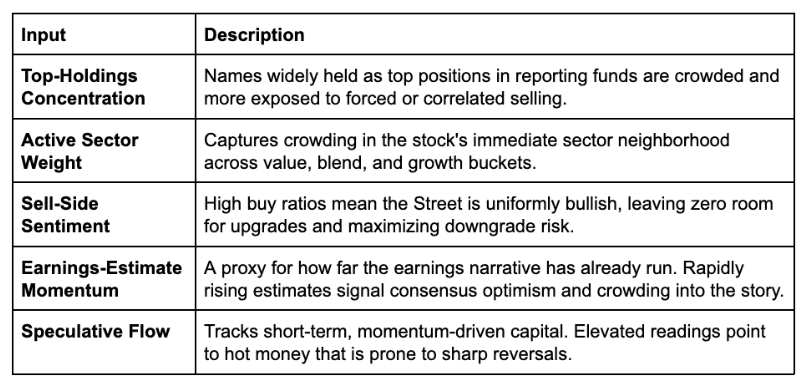
They are then combined into a single score accounting for region, size, and country. It is a daily score from 0 to 100, from least crowded to most.
Effectively, it measures whether the room is packed or nearly empty.
3. How to Test It
Earnings season is the best crowding test, because it's real news, good or bad. That’s why we tested our Crowding score with it across thousands of stocks over two decades.
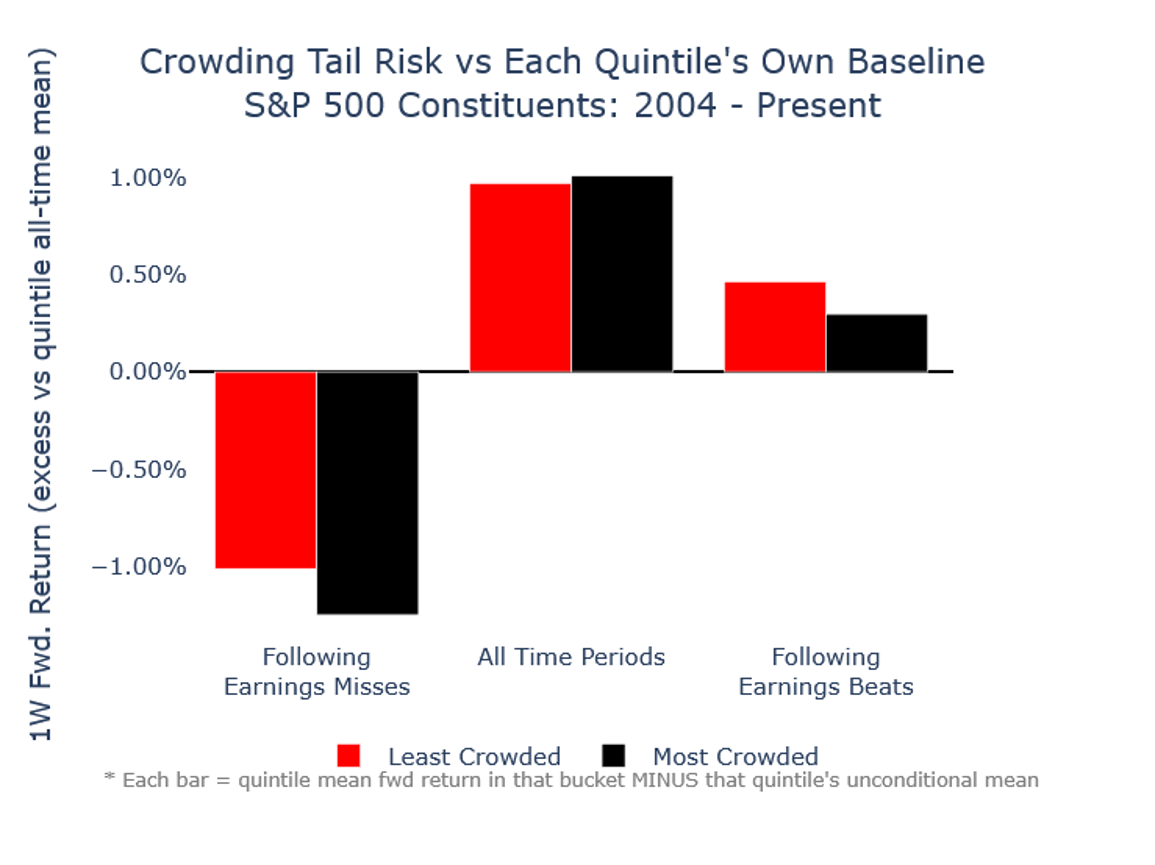
Look at the results for the S&P500 above.
When a stock misses earnings expectations, the most crowded stocks underperform more than the least crowded ones.
However, look to the far right, when the earnings beats expectations, the most crowded names also underperform.
In other words, crowded stocks capture less of the upside than their uncrowded peers.
When everyone's already positioned and expectations are sky-high, even a great quarter is disappointing. Unloved stocks, meanwhile, have nowhere to go but up: the bar is low and there are few sellers left to scare.
Munger's secret to life was low expectations. Apparently, it’s also a decent factor.
4. Uncrowded Stocks Are Not Perfect Either
Crowded stocks carry risk, but we don’t mean jump head-first into uncrowded ones.
Portfolios have to be careful of stocks with very low Crowding scores since it could hint at structural problems beyond standard accounting.
Our research showed that stocks on both ends of the Crowding score had much higher forward downside volatility. They both risked moving more on the downside than the upside.
If you look at the chart below, you can see it applies to S&P500 and DM Ex-US.
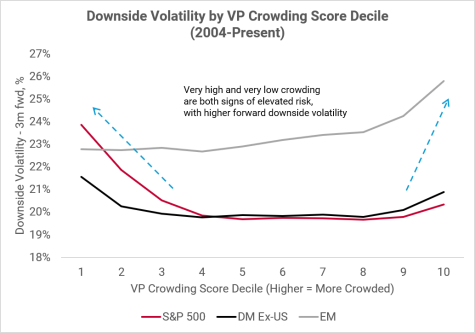
Both ends of the Crowding score carry risk. Sensible investors should look to invest in the ‘middle way’ to protect their portfolio.
5. Perpetual Crowd
If we know this is a known problem, why doesn’t the crowd bail? It’s because the incentives are all too human.
- Career risk: failing conventionally is better than succeeding unconventionally. So, owning what everyone owns is the safe career move, even if it's a bad bet.
- Stories beat statistics: narratives are how humans process reality– and how prices detach from it.
- FOMO: Watching a neighbour buy a catamaran thanks to a stock you don’t own is a painful experience.
We don’t mean to say crowds are stupid. Institutional favourites can be solid businesses.
The problem is price: by the time everyone loves it, the virtues are priced in and the risks are not.
6. Conclusion
Crowding is one signal we use as part of a larger radar system.
Our Capital Cycle flags industries with good long-term supply dynamics. Quality tells us if a business is built to last. Crowding just tells you when the room is too full — that’s when even a great business, in a great industry, becomes a risky bet.
Remember that popularity doesn’t offer safety.
In fact, crowded stocks give you the worst of both worlds: muted upside on good news, outsized pain on bad.
By measuring the crowd systematically– through flows, analyst sentiment, and fund positioning– we're really just trying to know, quietly, when to sit near the exit, or even avoid the room in the first place.
Other Insights
Practical insights on allocation, diversification, and risk tolerance—combining behavioral, liquidity, and structural perspectives.
.png)
Stay Connected
Our research is built for investors who need timely, repeatable insights.