

"The pessimist complains about the wind; the optimist expects it to change; the realist adjusts the sails." - William Arthur Ward
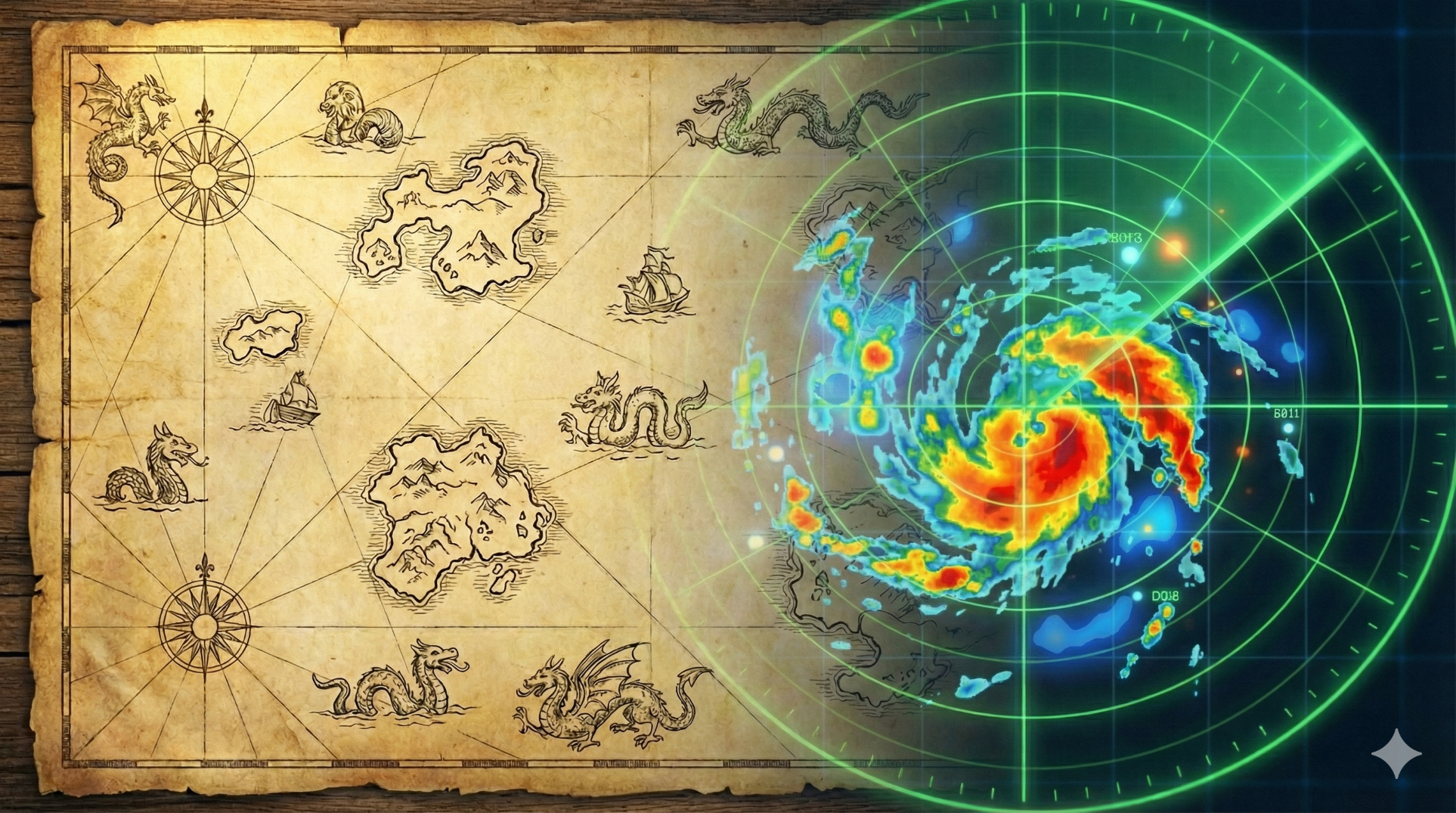
To cross an ocean, a captain needs two distinct tools.
First, they need a Map. The map is static. It represents the fundamental truths of geography: where the islands are and the location of the destination.
Second, they need a Radar. The radar is dynamic. It tells you where the storm clouds are forming right now, where other ships are moving, and what hazards lie immediately ahead.
In the world of investing, many strategies rely on just one.
Traditional finance is the Map. It focuses on valuation analysis, forecast returns and mean-variance optimization. These tools are vital, but more can be done.
Maps cannot see the weather. It cannot see the storm clouds of a liquidity crisis or the fog of inflation.
At Variant Perception, our investment philosophy is built on the belief that to reach your destination safely, you need both a Map and a Radar. The Map tells you where to go, and the Radar tells you when to act.
The Map: Structural Anchors
In our framework, the "Map" is built on Valuation and Structural Anchors. These are the slower-moving forces that define the landscape:
- Valuation: This is our coordinate system. It tells us if an asset is cheap or expensive.
- Quality & Capital Cycle: These are the physical features of the terrain—the mountains and the harbors. They change gradually over quarters and years, not days. We look for "Capital Scarce" industries where supply is constrained, and 'High Quality' businesses with durable moats.
Like a captain plotting a course to his destination, we use these slow-moving indicators to identify where the long-term winners are located.
The Radar: Adaptive Signals
Even the best map is useless if you sail straight into a hurricane. The market environment is prone to short and medium term shifts that can overwhelm and even shift structural fundamentals. This is where we need a Radar to scan for the weather:
- The Business Cycle: Is growth accelerating or decelerating? Is liquidity rising? These forces shift over weeks and months, changing the sailing conditions for every asset class.
- Behavioral Models: Is a trade too crowded? Are sentiment and flows reaching extremes? These are the sudden squalls and thick fog that can blindside an investor.
By building hierarchies and mapping connections between inputs, our quantitative models function like a radar sweeping the horizon. They allow us to be defensive when recession clouds gather and aggressive when the skies clear.
The Synthesis: Captain + Map + Radar
Ultimately, you need a captain, a map and a radar to reach your destination.
Valuations, Quality, and the Capital Cycle help us to set the destination. Leading Indicators and Behavioral models allow us to adapt to the conditions we face along the way.
Crucially, we are not a "Black Box."
We believe that investors must understand why a signal is flashing. For a fiduciary, a black box that spits out a trade without explanation is useless. Our models do the job of processing millions of data points without emotion, but our job as the Captain is to validate the signal, understand the causal mechanisms, and ensure the data makes fundamental sense.
Kaizen: A System That Improves
Finally, a good captain learns from every voyage.
We borrow the Japanese philosophy of Kaizen (continuous, incremental progress). A captain's log is never closed, and the navigation tools are never finished. Each lesson learned and each improvement in our indicators is folded back into a unified investment framework. This ensures our process compounds over time, becoming more resilient with every cycle.
The Takeaway
Successful investing is not about predicting the future with perfect accuracy. It is about preparation.
We aim to navigate the uncertainty of the markets with a Map and a Radar. We adjust our sails not because the destination has changed, but because the wind has.
Other Insights
Practical insights on allocation, diversification, and risk tolerance—combining behavioral, liquidity, and structural perspectives.

.png)
Stay Connected
Our research is built for investors who need timely, repeatable insights.